



By Stephen T. Sinatra, M.D., F.A.C.C., F.A.C.N., C.N.S., C.B.T.
I’ll bet you’ve heard that eating too much saturated fat is a recipe for heart disease due to high cholesterol, and that a very low-fat diet is your best bet for optimum heart health. Folks, we’re dealing with a medical myths and half-truth here.
Fact is, while eating saturated fat may raise your total cholesterol, it won’t give you heart disease. That’s right, cholesterol is not the real villain when it comes to heart disease, as we’ve been led to believe for decades. In fact, there is no study I am aware of that has ever convincingly demonstrated the relationship between eating saturated fat and heart disease. On the other hand, research does show that replacing saturated fat with carbohydrates can actually increase heart disease risk. So can replacing them with vegetable oils like canola oil. “The devil is in the details…”
Now, if saturated fats don’t cause heart disease, what does? Chronic arterial inflammation, for one, due, in part, to regular consumption of excess amounts of sugar and unhealthy fats.
Why Fat Became the Enemy
Remember the fat-free diet craze which began in the 1970s? Although well-intentioned and seemingly logical, the fat-free diet was based on a severe misunderstanding about dietary fat, and likely contributed to the current “diabesity” epidemic. Confident that, “as long as it was fat-free, it was okay,” many dieters compensated for lack of fat in the diet with sugar, often in unrestricted amounts. As people began to eating an abundance of carbohydrates, their insulin levels chronically soared. We now recognize that regular, excess insulin release can lead to insulin resistance and subsequent weight gain.
Now, it’s usually pretty easy to differentiate between healthy and unhealthy sources of sugar, or carbohydrates: as a general rule of thumb, the less processed or refined a carbohydrate is, the better. Carbohydrates in their most unrefined states, such as fresh vegetables and fruits, are your best choices to prevent inflammation, while candies, cookies, chips, white bread, and pastas – all processed carbs – can fan the fires of inflammation.
Why You Need Fats
Fats, on the other hand, are often misunderstood (even by doctors) when it comes to heart health. You need fats for several reasons, such as: to burn for energy, for proper heart and brain function, and to absorb fat-soluble vitamins like A, D, E, and K, as well as plant nutrients known as carotenoids. Fats are satiating: by adding them to your meals, you may actually eat less in the long run. Additionally, since fats don’t require insulin to be digested, they can actually help you lose weight (since you’ll more easily burn your fat reserves).
Bottom line – healthy fats should comprise approximately 35 to 40 percent of our daily caloric intake.
Which fats are healthy and which aren’t?
Our understanding of the healthiness or unhealthiness of fats constantly evolves. We now know that chronic inflammation and oxidized LDL cholesterol are major players in the development of heart disease. Hence, we now consider fats which contribute to inflammation and the oxidation of LDL cholesterol, rather than those that simply convert to cholesterol, unhealthy.
Types of Fats
To determine which fats are most and least inflammatory, we look at their chemical structure, specifically the type of fatty acids they contain; this will tell us how stable, or resistant to heat the fats are, and whether they will oxidize easily. (As oxidative damage is a major promoter of heart disease, oxidation of fats is of significant concern.) There are 3 families of natural fatty acids:
- Polyunsaturated (include omega-3, omega-6 and omega-9) fatty acids – are the least stable and most easily oxidized;
- Monounsaturated fatty acids – are more stable and less easily oxidized than polyunsaturates;
- Saturated fatty acids – are the most stable in high heat and do not oxidize easily.
Partially-hydrogenated oils, or trans fatty acids (monounsaturated or polyunsaturated fatty acids with artificially added hydrogen atoms) make up a man-made 4th class (a kind of “Franken-fat,” if you will).
Unsaturated fats are liquid at room temperature, while saturated fats are solid at room temperature and liquefy when heated. Most foods contain a different combination of fats.
Monounsaturated fats
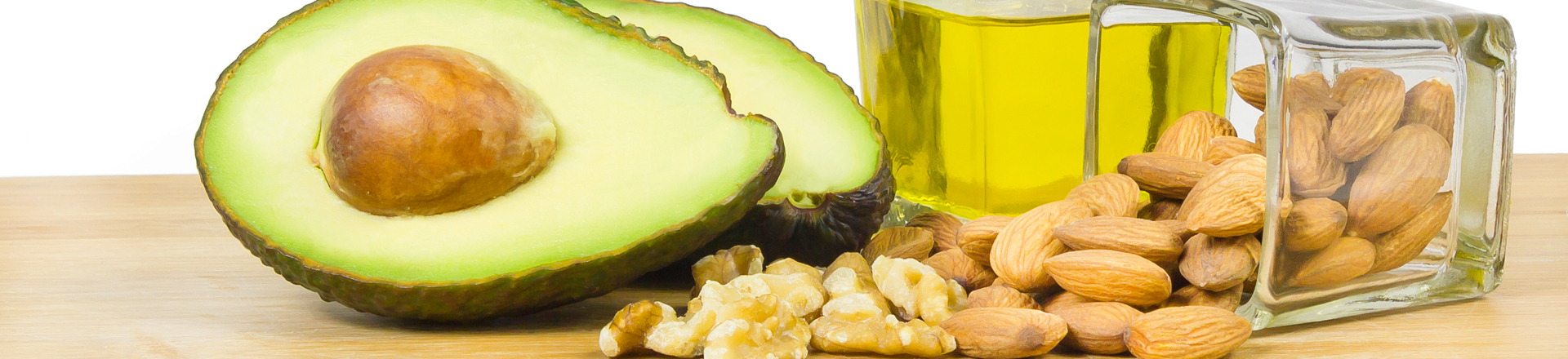
As a main fat in the Mediterranean diet, the health benefits of monounsaturated fats are well documented: in virtually every research study conducted, monounsaturated fats have been shown to be associated with lower levels of heart disease and cancer, as well as longer life spans. Anti-inflammatory monounsaturated fats are relatively stable and tend not to oxidize easily. While olive oil is probably the best source of monounsaturated fat, we can also get it through foods like avocados, and various seeds and nuts. Olive oil is best consumed in uncooked form, since high heat can damage its health-enhancing compounds.
Polyunsaturated fats: Omega-3s, Omega-6s and Omega-9s
A double-edged sword when it comes to health, polyunsaturated fats can be inflammatory and can oxidize quickly in our bodies, which makes our cells more vulnerable to degenerative diseases like heart disease. We need to consume some polyunsaturated fats, though, because they contain essential fatty acids (EFAs). EFAs are “essential” because we don’t make them in our bodies, i.e. we must get them through the diet and possibly supplements.
There are two major EFAs in polyunsaturated fats: alpha-linolenic acid (ALA) and linoleic acid (LA), also known as omega-3s or omega-6s, respectively. From ALA, our bodies produce two other crucially important fatty acids: eicosapentaenoic acid (EPA) and docosahexaenoic acid (DHA).
We need omega-3 fatty acids for brain function and normal growth and development. Omega-3s are also anti-inflammatory and cardio-protective: studies have also shown that higher omega-3 consumption, especially through dietary sources of EPA and DHA, is associated with lowered risk of heart disease. While fish and squid (and fish or squid oil) are the best sources of EPA and DHA, flaxseed, walnuts, and chia are all good sources of the ALA that our bodies can convert into EPA and DHA. Try to find a pure, uncontaminated fish oil that contains both EPA and DHA, and/or eat small migratory fish like wild-caught Alaskan salmon, Atlantic halibut, and cod; avoid larger and farm-raised fish.
In addition to omega-3s, we need also need small amounts of omega-6s, which are essential for brain and reproductive health, as well as for bone, skin, and hair development. Linoleic acid (LA), which is inflammatory, tends to be the primary type of omega-6 we consume, perhaps due to its prevalence in vegetable oils (e.g. canola, corn, cottonseed, safflower, soy, and sunflower), as well as in processed foods which contain these oils. Ideally, we should consume an equal amount of omega 3s and omega 6s to balance inflammatory activity.
Saturated fats
Primarily found in animal products such as butter, meat, cheese, and eggs, saturated fats are also present in certain plant foods like palm oil, coconut oil and coconut. Saturated fats are the most resistant to oxidation and much more stable under high heat than unsaturated fats, making butter and coconut oil better choices to cook with than olive or canola oils. With animal sources, it’s best to choose organic, wild-caught or free range varieties, as conventionally-produced products tend to contain more environmental toxins, which can be inflammatory.
Saturated fat tends to convert to cholesterol in the body, which you need, in certain amounts, to maintain the integrity of your cell membranes, to produce cellular structures and hormones, and for digestion. While your body makes about 85 percent of its cholesterol, you get the rest from dietary sources, like saturated fats.
Although saturated fat can contribute to LDL cholesterol (often deemed “bad” without regard to particle subtype), it primarily increases LDL subtype A, or LDL-A, particles. Buoyant and fluffy, LDL-A particles are less invasive and less inflammatory than LDL subtype B, or LDL-B particles. LDL-Bs are highly inflammatory in that they oxidize, stick to artery walls, and begin the cascade of atherosclerotic damage.
Which brings us to…
Partially hydrogenated oils or trans- fats
Hands down, partially-hydrogenated oils / trans fats are the unhealthiest fats around. Trans fats are vegetable oils to which an extra hydrogen molecule has been artificially added. They may be found in processed foods like margarine, fast foods, and commercial baked goods, as well as in fried foods. While adding the hydrogen molecule makes these fats solid at room temperature and increases their shelf life, it does nothing to increase our shelf lives.
Consumption of trans fats severely increases inflammation in our bodies through free radical damage to cell membranes and oxidation of LDL cholesterol particles. Not only are trans fats associated with the development of heart disease, but they are also linked to increased risk of some cancers.
What You Need to Know: the Skinny on Fats
To boil it all down, here are some general rules of thumb:
- Choose foods with fats that are primarily monounsaturated – like olive oil – or contain omega-3 polyunsaturated fats – like small, wild migratory fish – because these fats are anti-inflammatory;
- Eat omega-6 polyunsaturated fats in small amounts (they are essential, but inflammatory);
- Consume saturated fats in moderation, as part of a healthy, anti-inflammatory diet full of fresh fruits and vegetables;
- Read nutrition labels and avoid, as much as possible, anything with the words “hydrogenated,” or “partially hydrogenated.” Also avoid fast foods.
To your great health!
References and additional resources:
- Bowden J, Sinatra ST. The Great Cholesterol Myth Cookbook: Recipes & Meal Plans That Prevent Heart Disease –Naturally (Beverly, MA: Fair Winds Press, 2014).
- Bowden J, Sinatra ST. The Great Cholesterol Myth: Why Lowering Your Cholesterol Won’t Prevent Heart Disease and the Statin-Free Plan that Will (Beverly, MA: Fair Winds Press, 2012).
- Chapkin RS, Kim W, Lupton JR, McMurray DN. Dietary docosahexaenoic and eicosapentaenoic acid: emerging mediators of inflammation. Prostaglandins Leukot Essent Fatty Acids. 2009;81:187–191. [Free Full Text]
- Harris WS, Mozaffarian D, Rimm E, et al. Omega-6 Fatty Acids and Risk for Cardiovascular Disease: A Scientific Advisory from the American Heart Association Nutrition Subcommittee of the Council on Nutrition, Physical Activity, and Metabolism; Council on Cardiovascular Nursing; Council on Epidemiology and Prevention. Circulation, Feb 2009; 119: 902 – 907. [Free Full Text]
- Hu FB, Bronner L, Willett W, et al. Fish and Omega-3 Fatty Acid Intake and Risk of Coronary Heart Disease in Women. JAMA. 2002;287:1815-1821. [Free Full Text]
- Kim J, Lim SY, Shin A, et al. Fatty fish and omega-3 fatty acid intakes decrease the breast cancer risk: a case-control study. BMC Cancer. 2009; 9: 216. [Free Full Text]
- Lopez-Garcia E, Schulze MB, Meigs JB, et al. Consumption of trans-Fatty Acids is Related to Plasma Biomarkers of Inflammation and Endothelial Cell Dysfunction. J. Nutr. (March 2005) 135:562-566. [Free Full Text]
- National Institutes of Health Office of Dietary Supplements Web Site.Omega-3 Fatty Acids and Health.
- Simpolous AP. The Importance of the Omega-6/Omega-3 Fatty Acid Ratio in Cardiovascular Disease and Other Chronic Diseases. Exp. Biol. Med. 2008;233(6):674-688. [Free Full Text]
- Theodoratou E, McNeill L, Cetnarskyj R, et al. Dietary Fatty Acids and Colorectal Cancer: A Case Control Study. Am. J. Epidemiol.(2007) 166 (2): 181-195. [Free Full Text]
- Vinikoor L, Schroeder J, Millikan R, et al. Consumption of trans-Fatty Acid and Its Association With Colorectal Adenomas. Am. J. Epidemiol.(2008) 168 (3): 289-297. [Free Full Text]
© 2014, 2018 HeartMD Institute. All rights reserved.